

A New Dimension of Learning Takes Shape in American Classrooms
Picture a biology class in Ohio where students dissect a virtual frog hovering above their desks, or a history lesson in Texas where the Alamo rebuilds itself in 3D before students’ eyes. This is not science fiction. Augmented Reality in Education is already reshaping how millions of American students learn.
Schools across the country are experimenting with AR technology in classrooms at a pace few predicted just five years ago. According to recent industry projections, the global AR in education market is expected to surpass $5.3 billion by 2028.
Why This Shift Matters Now
Traditional teaching tools often struggle to hold student attention in a digital-first world. Technological integration in education through AR offers a bridge between static textbooks and dynamic, immersive experiences.
Consider what makes this technology so compelling for educators nationwide:
- Interactive 3D models that turn abstract concepts into tangible visuals
- Real-time feedback systems that adapt to individual learning speeds
- Increased engagement rates, with studies showing up to 90% improvement in information retention
- Accessibility features that support diverse learning needs
What This Article Will Uncover
The benefits of augmented reality education extend far beyond novelty. From elementary schools in California to universities in New York, institutions are documenting measurable improvements in comprehension and motivation.
This exploration will examine practical AR tools for learning, real classroom case studies, and emerging challenges. Readers will also discover expert predictions about the future of augmented reality in education and what it means for students, teachers, and school districts preparing for the next decade.
DISCOVER MORE: Click here for essential mental health support tips
From Pilot Programs to Mainstream Adoption
Just a decade ago, Augmented Reality in Education existed mostly in university research labs. Today, it sits inside backpacks and tablets carried by students from Seattle to Miami.
School districts in Florida, Georgia, and California have launched pilot programs integrating AR headsets and mobile applications into daily lesson plans. What began as isolated experiments has grown into a broader movement toward technological integration in education that administrators can no longer afford to ignore.
The Numbers Behind the Momentum
Data from education technology researchers paints a striking picture. Over 70% of K-12 educators surveyed in recent studies expressed interest in adopting AR tools within the next three years. Meanwhile, higher education institutions are moving even faster, with medical and engineering programs leading adoption rates.
This growth is not happening in isolation. It reflects a wider pattern of classrooms embracing digital transformation, where AR functions as one piece of a much larger technological puzzle.
How AR Actually Works in the Classroom
Understanding AR technology in classrooms starts with a simple concept: overlaying digital information onto the physical world. Students point a tablet or wear a headset, and suddenly a textbook diagram becomes a rotating 3D structure they can examine from every angle.
Several practical applications are already gaining traction nationwide:
- Chemistry students in Chicago visualizing molecular bonds forming in real time
- Geography classes in Arizona exploring topographic maps that rise from flat paper
- Special education programs using AR to create customized sensory experiences
- Vocational training centers simulating equipment repairs without physical risk
Each example demonstrates a core advantage: AR tools for learning transform passive observation into active exploration. Students are not simply told how a heart pumps blood; they watch it happen inches from their eyes.
Early Evidence of Impact
Researchers tracking classroom outcomes have started publishing compelling figures. One widely cited study found that students using AR-enhanced materials scored notably higher on comprehension tests compared to peers using traditional methods alone.
Beyond test scores, teachers report something equally significant: sustained attention. In an era where digital distractions compete constantly for student focus, AR content captures interest by making learning feel less like instruction and more like discovery.
Still, these early results raise an important question that educators, parents, and policymakers are only beginning to answer: how far can this technology realistically go inside American schools?
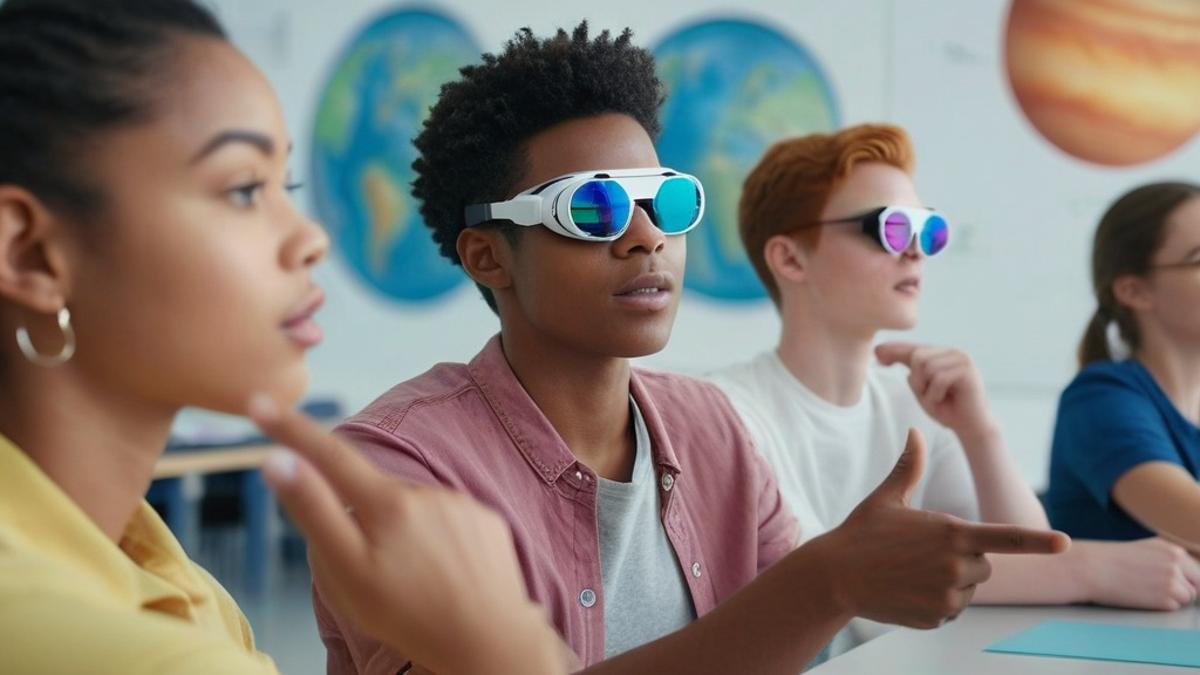
| Category | Key Features & Benefits |
|---|---|
| AR Tools in Classrooms | Utilization of AR applications fosters engagement by providing interactive learning experiences, making complex subjects more accessible and enjoyable. |
| Benefits of AR Education | Enhanced retention of knowledge, improved spatial awareness, and the ability to conduct virtual simulations create immersive educational scenarios, thus revolutionizing learning dynamics. |
DIVE DEEPER: Click here to explore innovative online learning platforms
Barriers Standing Between Classrooms and Full Adoption
Enthusiasm for Augmented Reality in Education runs high, but rolling out this technology across thousands of school districts is far from simple. Budget constraints remain the most immediate obstacle facing administrators nationwide.
A single classroom set of AR headsets can cost school districts anywhere from $3,000 to $15,000, depending on the hardware. For rural districts in states like Mississippi or West Virginia, that price tag often competes directly with basic infrastructure needs.
The Digital Divide Gets a New Dimension
Equity concerns extend beyond simple device access. Technological integration in education requires reliable broadband, updated tablets, and IT support staff capable of troubleshooting immersive software.
Urban districts in cities like Boston or San Francisco often secure grant funding and corporate partnerships that smaller communities simply cannot match. This gap raises a pressing question: will AR become another tool that widens achievement disparities rather than closing them?
Some organizations are working to counter this trend. Nonprofit initiatives partnering with tech companies have begun donating AR kits to underserved schools in Texas and Ohio, hoping to prevent a two-tiered system of digital learning.
Training Teachers for a New Kind of Classroom
Hardware is only part of the equation. Teachers themselves need substantial preparation to use AR tools for learning effectively.
Surveys show that fewer than 40% of educators currently using AR received formal training before implementation. Many learned through trial and error, YouTube tutorials, or informal peer mentoring during lunch breaks.
This gap has prompted several state education departments, including those in North Carolina and Colorado, to introduce professional development workshops focused specifically on immersive technology.
Comparing AR With Its Virtual Reality Counterpart
Confusion often arises between AR and VR, yet the distinction matters significantly for classroom planning. While virtual reality immerses students in entirely simulated environments, AR overlays digital elements onto real surroundings, keeping learners grounded in physical space.
This difference translates into practical advantages:
- Lower motion sickness risk compared to fully immersive VR headsets
- Easier integration into existing classroom furniture and layouts
- Reduced isolation, since students can interact with peers while using devices
- Generally lower hardware costs than high-end VR systems
These factors explain why many districts view the benefits of augmented reality education as more immediately achievable than large-scale VR deployment, at least in the short term.
What Comes Next for Classrooms Nationwide
The evidence gathered across classrooms from Seattle to Miami points to a clear pattern: Augmented Reality in Education is no longer a novelty confined to tech-forward pilot programs. It has become a measurable force reshaping how students engage with biology diagrams, historical timelines, and abstract math concepts.
Yet the path forward remains uneven. Budget gaps, spotty broadband, and inconsistent teacher training show that technological integration in education cannot succeed through hardware alone. Districts need sustained investment in infrastructure and professional development, not just one-time grants for shiny headsets.
Weighing Promise Against Practical Limits
Schools experimenting with AR technology in classrooms report tangible gains in engagement and retention, particularly among students who struggle with traditional textbook instruction. These outcomes explain why administrators in dozens of states continue pushing pilot programs forward despite financial pressure.
Still, the comparison with virtual reality suggests something important: adoption doesn’t require the most immersive or expensive option. Sometimes the more grounded, cost-effective tool delivers the strongest classroom results.
A Technology Worth Watching Closely
The future of augmented reality in education will likely depend less on the technology itself and more on how equitably it reaches schools in Appalachia, the Mississippi Delta, and inner-city Chicago alike.
Parents, educators, and policymakers now face a shared responsibility: ensuring that innovation doesn’t outpace access. As pilot programs expand and data accumulates over the next several years, one thing seems certain. The conversation around AR tools for learning has only just begun, and its next chapter will shape how an entire generation experiences education.
Frequently Asked Questions
How can Augmented Reality enhance classroom learning experiences?
Augmented Reality (AR) can enhance classroom learning by providing interactive, immersive experiences that engage students in unique ways. For instance, AR can bring complex subjects like physics or biology to life, allowing students to visualize and interact with 3D models of molecules or celestial bodies. This hands-on approach promotes better understanding and retention of information.
What are some examples of Augmented Reality applications used in education?
There are several AR applications used in education, such as Google Expeditions, which allows students to take virtual field trips around the world, and Merge Cube, which enables students to interact with 3D holograms using their mobile devices. Additionally, applications like Quiver bring coloring pages to life, making art and creativity more interactive for younger students.
What are the challenges of integrating Augmented Reality in schools?
Integrating Augmented Reality in schools can present challenges such as the need for adequate technology infrastructure and training for teachers. Additionally, there may be initial costs for AR tools and devices, which can pose a barrier for some educational institutions. Ensuring that the content is aligned with curricular goals is also crucial for successful implementation.
Is Augmented Reality suitable for all age groups in education?
Yes, Augmented Reality can be adapted for various age groups, from preschoolers to university students. For younger children, simple interactive games and applications can enhance basic learning concepts, while older students can benefit from more complex simulations and modeling applications that support higher-order thinking skills. Customization ensures AR is effective for different learning stages.
How does Augmented Reality improve student engagement in subjects like science and history?
Augmented Reality improves student engagement in subjects like science and history by providing a more immersive and participatory learning experience. Students can explore historical events through AR reconstructions or conduct science experiments virtually, transforming theoretical knowledge into practical experiences. This active participation fosters curiosity and enthusiasm for learning.